
You have decided to start tackling projects around the house on your own, but are not sure what tools to start with. While it takes time to build up a tool collection, there are certain tools that I use on almost every single project. Start with the more basic tools first and then as you do more projects, upgrade to the tools with more bells and whistles. To ensure cost efficiency, only buy the tools necessary for completing the project you are currently working on.
Before diving into any power tools, make sure that you have proper safety equipment. Any time a power tool is being used, you should always wear eye and lung protection (goggles/glasses and face mask), often times hearing protection. Make sure to read the safety precautions in the tool manual prior to turning it on to avoid any injuries. Obtain any additional PPE (Personal Protective Equipment) recommended in the user manual prior to tool usage.

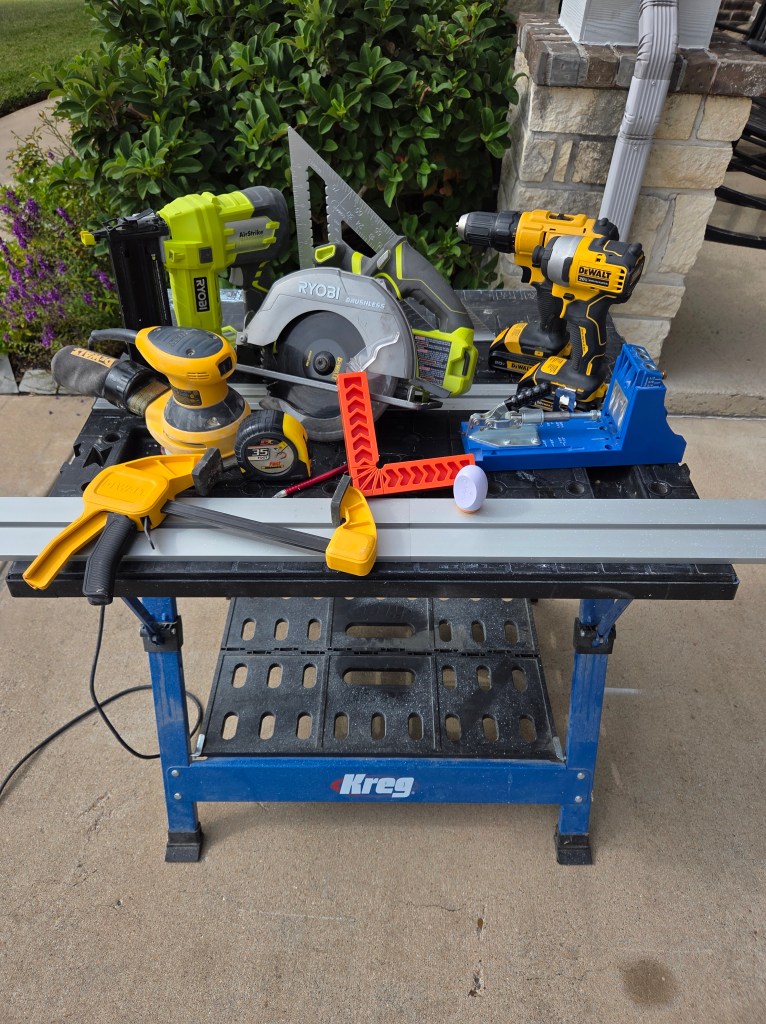
The list below are tools that I personally use on almost every single project and are beginner-friendly.
Circular Saw and Straight Edge
There are tons of different types of saws, but I have found the most versatile to be the circular saw with a fine finish blade, run along a straight edge. Most circular saws do not come out of the box with a fine finish blade, so make sure to grab one before you leave the store. A fine finish blade plus painters tape on the cut line and a slow and steady saw make for the best possible outcomes when cutting plywood.
Drill and Driver
My first power tool was gifted by my brother when I bought my first home (thanks, Michael!). It is a cordless DeWalt Drill/Driver combo and by far my most used tool in my workshop. I also have the cordless DeWalt Impact Driver which is especially helpful when mounting cabinets to the wall or anytime additional torque is needed. These tools can be used in a wide application which makes them incredibly versatile. There are also many different drill attachments for other useful applications, one of my personal favorites is the scrub brush attachment that we have used to clean car wheels and spots on the back patio.
Pocket Hole Jig
Pocket hole jigs are used to drill a pilot hole at an angle to join two pieces together. Most frequently used for building cabinetry, there are many applications for a pocket hole jig – frames for floating shelves, bookshelves, drawers, etc. A pocket hole screw plus wood glue makes for an extremely strong joint.
Measuring Tools
My tape measure is arguably the most dangerous tool in my garage. It signals the beginning of something! All projects require a tape measure, but other measuring tools that are especially helpful are a pencil (hello!), and various carpenter’s squares (Rafter Square and Framing Square).
Electric Sander
An electric or battery powered orbital sander will be a top-used tool whenever doing a home project. Mine is a corded DeWalt orbital sander that was a hand-me-down and I use it constantly. The Diablo SandNet discs are what I recommend because they last longer than a traditional piece of sandpaper since the build-up doesn’t gunk up the pad.
Stud Finder
Choosing the appropriate stud finder depends on what type of project you’re working on. When installing the cabinets in the laundry room, I used the Walabot DIY so that I knew where the water lines and electrical all were and wouldn’t accidentally drive a screw through any of them. While I love my Walabot, my favorite stud finder is the most basic and most people probably have one in their home without realizing it – a magnet. If your home has drywall, knock on the wall horizontally until you hear a difference in the pitch of the knock and then run a magnet over the area until it magically sticks to the wall. The magnet is attracted to the drywall screw driven into the stud to hang the sheetrock. Once the screw is located, use a level and draw a level line vertically and that will mark the center of the stud.
Brad and Pin Nailers
Brad and Pin Nailers are arguably a slightly more advanced tool, but wanted to include it in this list as they have a wide use application. I would not recommend purchasing a brad/pin nailer unless your project specifically calls for it. That being said, these are tools that I reach for frequently and make life easier. My favorites are the Ryobi AirStrike 18 gauge brad nailer and Ryobi AirStrike pin nailer. They do not require a compressor, are easily portable, and uses a battery that is interchangeable for other tools in the Ryobi lineup.
Clamps
Clamps are a second set of hands when you are working alone, and are also helpful to hold pieces together while glue dries. My most used clamps are the DeWalt 36 inch 600 lb trigger clamps. I especially like these because they can fit around larger pieces, like a cabinet box, and used to hold items to a workbench or a smaller application. While I would only recommend purchasing clamps used for the project you’re currently working on, other clamps that are especially helpful are bar clamps, right angle clamps, and pocket hole clamps.
Work Table
A work table is necessary for safety and comfort. There are many types of work tables and work benches on the market in a wide price range, or you can build one, re-purpose a piece of furniture, or even use a simple folding card table, depending on what you’ll be using it for. I have the Kreg work table and I love it because it folds flat so storage is simple but it’s very heavy duty. There are multiple places to place clamps and it is versatile in that other clamp brands will work with this table, though Kreg offers some that make it extra helpful. From a safety perspective, clamping work pieces to the table will ensure they don’t turn into a projectile and potentially cause injury and provides stability when using power tools. Additionally, if drilling or cutting through a workpiece, a certain amount of clearance will be necessary underneath. This can be solved by either clamping the piece to the table and leaving the cut part hung off of the table or by clamping a sacrificial piece in between the workpiece and the table.
Supplies to Always Have In Stock
- Painters tape – can be used for a wide variety of applications, but the most used in my projects are on a cut line to minimize tear-out
- Sanding discs – my personal favorite are the Diablo sanding nets
- Sanding blocks
- Wood glue
- Caulk
- Pocket hole screws
- Basic screws – my favorite are PowerPro screws
- Wood filler: Plastic Wood, Bondo, wood glue mixed with sawdust, etc.
- Brad and pin nails

Additional posts are coming about more advanced tools that have become favorites and tips and tricks for more professional results, but this is a great starting point if you are wanting to dip your toe in the DIY pool and start learning. Let me know in the comments if you would add anything to this list or if you’d like to see a tutorial for any of these tools!
